
Three-stage launch vehicle, expendable
Saturn V
The three-stage heavy-lift launch vehicle developed for Apollo lunar missions, represented here in its crewed lunar-mission configuration.
- Height
- 111m
- Liftoff thrust
- 7,500,000lbf
- Payload to LEO
- 118,000kg
- Expendable
- First flight
- 1967
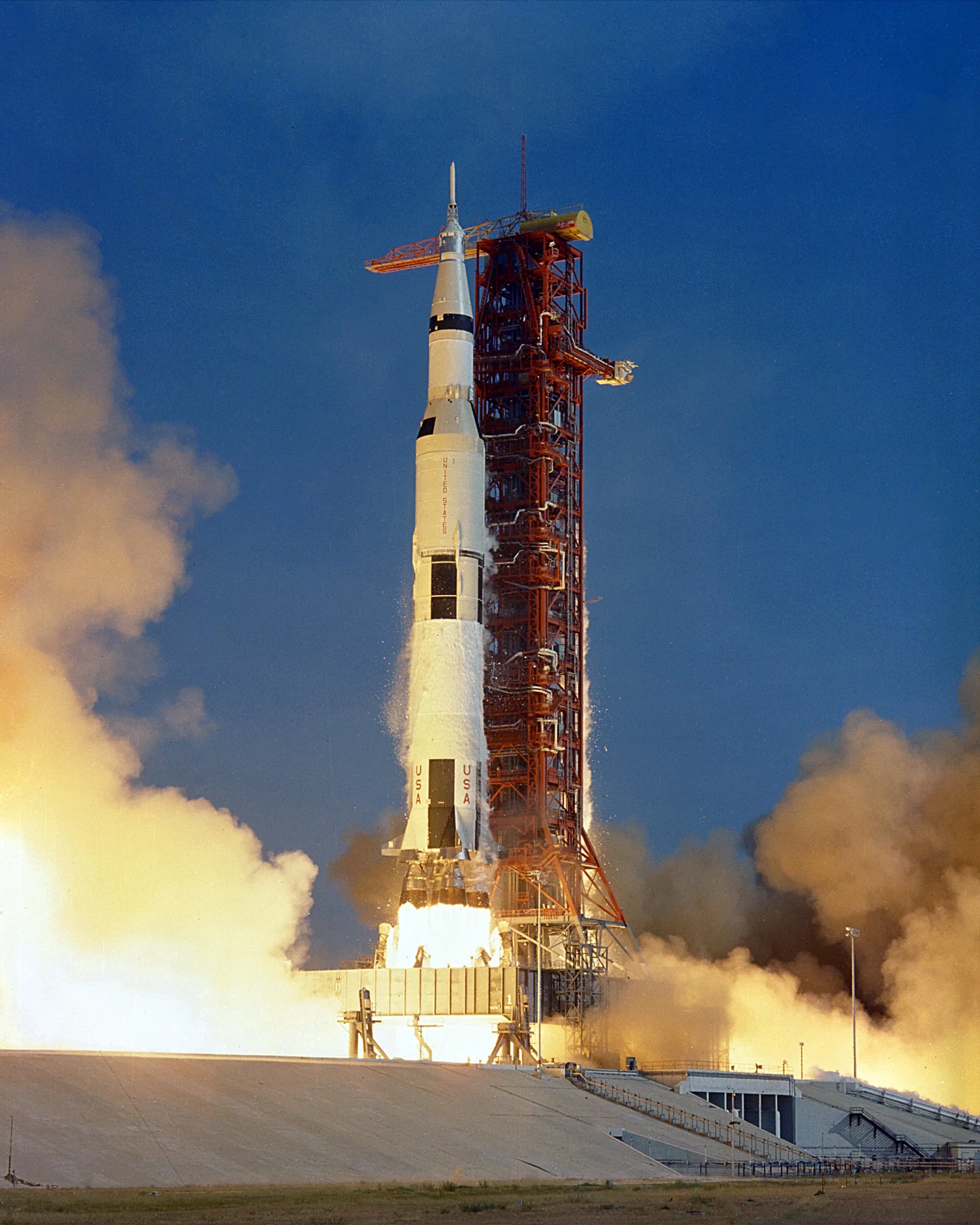

Overview
- Manufacturer
- NASA and Apollo prime contractors
- Country
- United States
- First flight
- Stages
- 3
- Engines
- 11 in total
Engineering analysis
Staging
Saturn V used different propellants for different phases of the lunar mission. The S-IC first stage burned RP-1/LOX for very high liftoff thrust, and the S-II and S-IVB burned hydrogen and oxygen for efficient upper-stage flight. The S-IVB could restart in orbit for translunar injection.
Structures
Saturn V’s structure carried millions of pounds of propellant and the engine, aerodynamic and staging loads, and still had to be light enough to reach the Moon. The S-IC alone stood 138 feet tall, and structural mass competed directly with payload and propellant.
Specifications
Size, mass and thrust at liftoff as published, with the basis of each figure.
Saturn V key specifications
| Parameter | Figure | Basis |
|---|---|---|
| Height | 111 m364.2 ftApproximate | Approximate |
| Liftoff mass | 2,800,000 kg6,173,000 lbApproximate | Approximate |
| Liftoff thrust | 7,500,000 lbf33,360 kNApproximate | Approximate |
Published figures are shown as recorded. The figure under each one, in the other unit system, is converted by ORBIX and rounded to four significant figures or one decimal place, whichever is coarser. A figure with no qualifier is a published or nominal value.
Stages
Each stage element in flight order, with its propellants, engines and whether it is designed to be recovered.
Saturn V stages
| Element | Stage | Propellants | Engines | Recovery |
|---|---|---|---|---|
| S-IC first stageRP-1 with liquid oxygen5 × F-1Expended | 1 | RP-1 with liquid oxygen | 5 × F-1 | Expended |
| S-II second stageLiquid hydrogen with liquid oxygen5 × J-2Expended | 2 | Liquid hydrogen with liquid oxygen | 5 × J-2 | Expended |
| S-IVB third stageLiquid hydrogen with liquid oxygen1 × J-2Expended | 3 | Liquid hydrogen with liquid oxygen | 1 × J-2 | Expended |
Propulsion
Thrust is per engine, where a figure is published. A rocket engine produces more thrust in vacuum because no outside air pressure acts against its exhaust.
Saturn V engines by stage
| Engine | Sea level | Vacuum | Stage | Cycle |
|---|---|---|---|---|
| F-15 engines, RocketdyneS-IC first stageGas generator | 1,500,000 lbf6,672 kNApproximate | Not published | S-IC first stage | Gas generator |
| J-25 engines, RocketdyneS-II second stageGas generator | Not published | 1.03 MN231,600 lbfApproximate | S-II second stage | Gas generator |
| J-21 engine, RocketdyneS-IVB third stageGas generator | Not published | 1.03 MN231,600 lbfApproximate | S-IVB third stage | Gas generator |
Performance
Payload mass depends on the destination orbit and on whether boosters are recovered, so each figure is tied to both.
Saturn V payload capability
| Destination | Payload | Configuration |
|---|---|---|
| Low Earth orbit (LEO)Expendable | 118,000 kg260,100 lbApproximate | Expendable |
| Trans-lunar injection (TLI)Expendable | 43,500 kg95,900 lbApproximate | Expendable |
The record also lists Earth escape as a supported destination, with no published payload figure.
Photographs
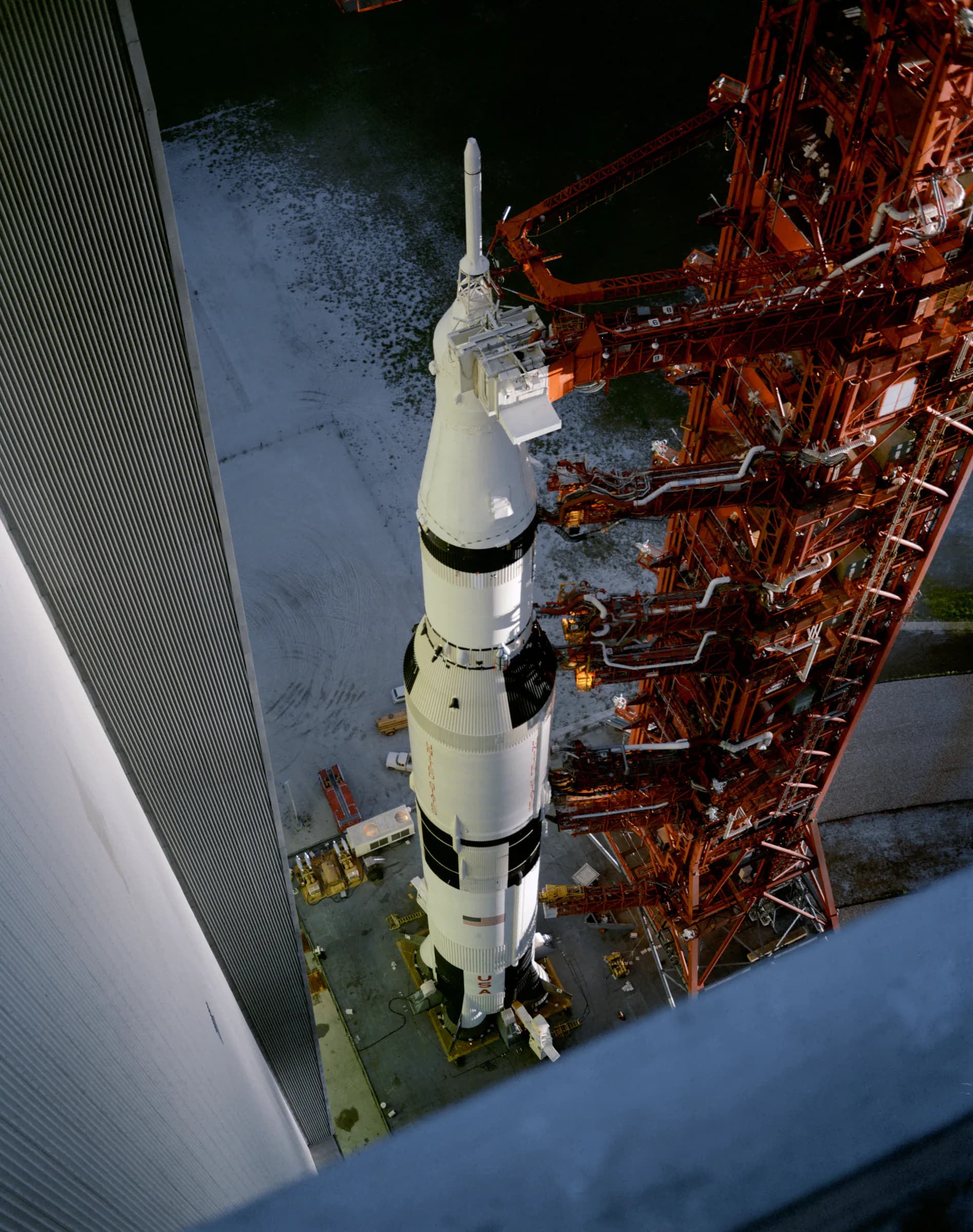
The Apollo 12 Saturn V leaving the Vehicle Assembly Building, September 1969. Photo: NASA. Public domain. Source file. 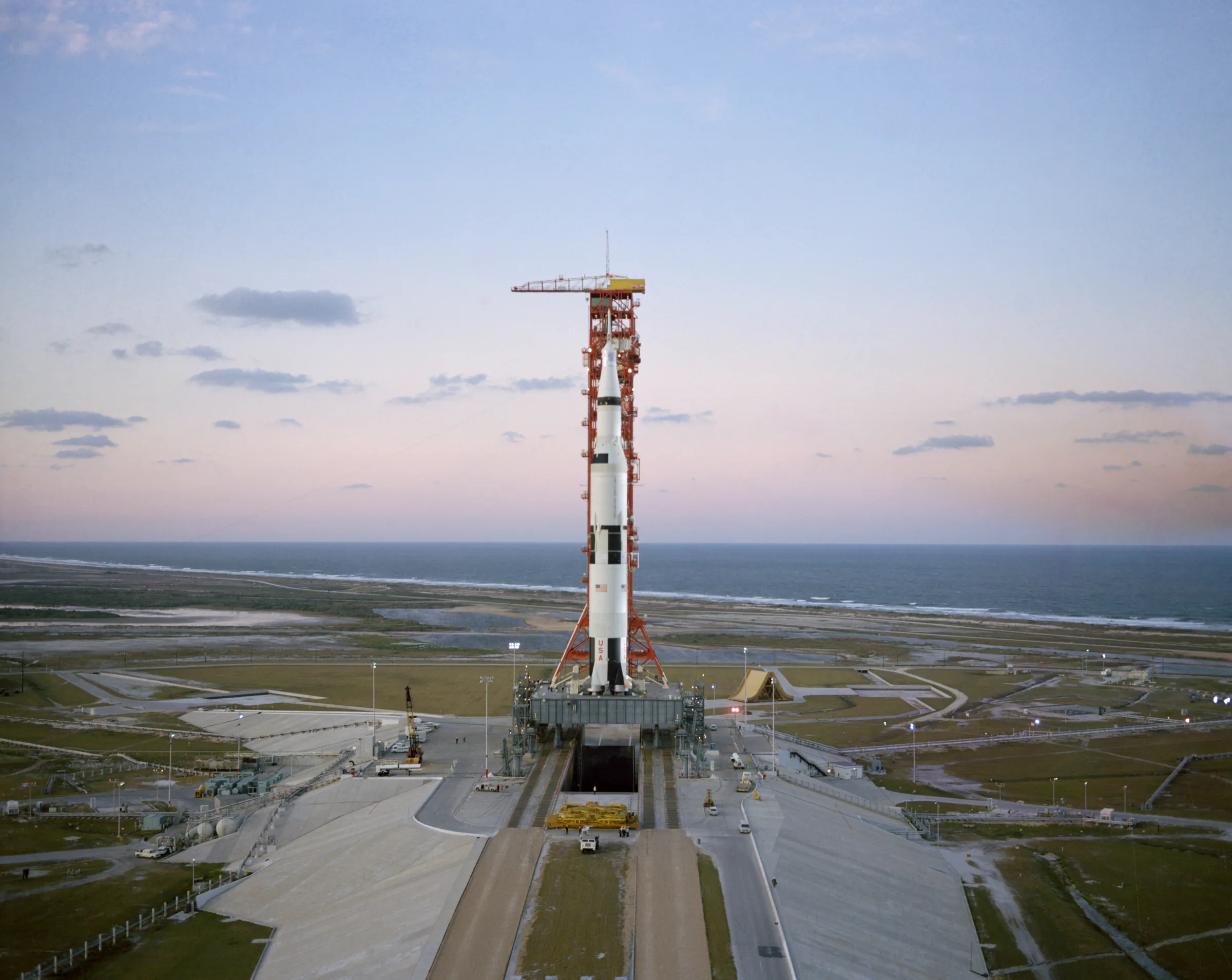
The Apollo 8 Saturn V on Pad A, Launch Complex 39, December 1968. Photo: NASA. Public domain. Source file.

